
Hand-picking:whatweactuallyinspect.
A short field guide to the inspection criteria — grain consistency, edge condition, surface uniformity, dimensional tolerance.
By the KHADANE desk · Bijolia
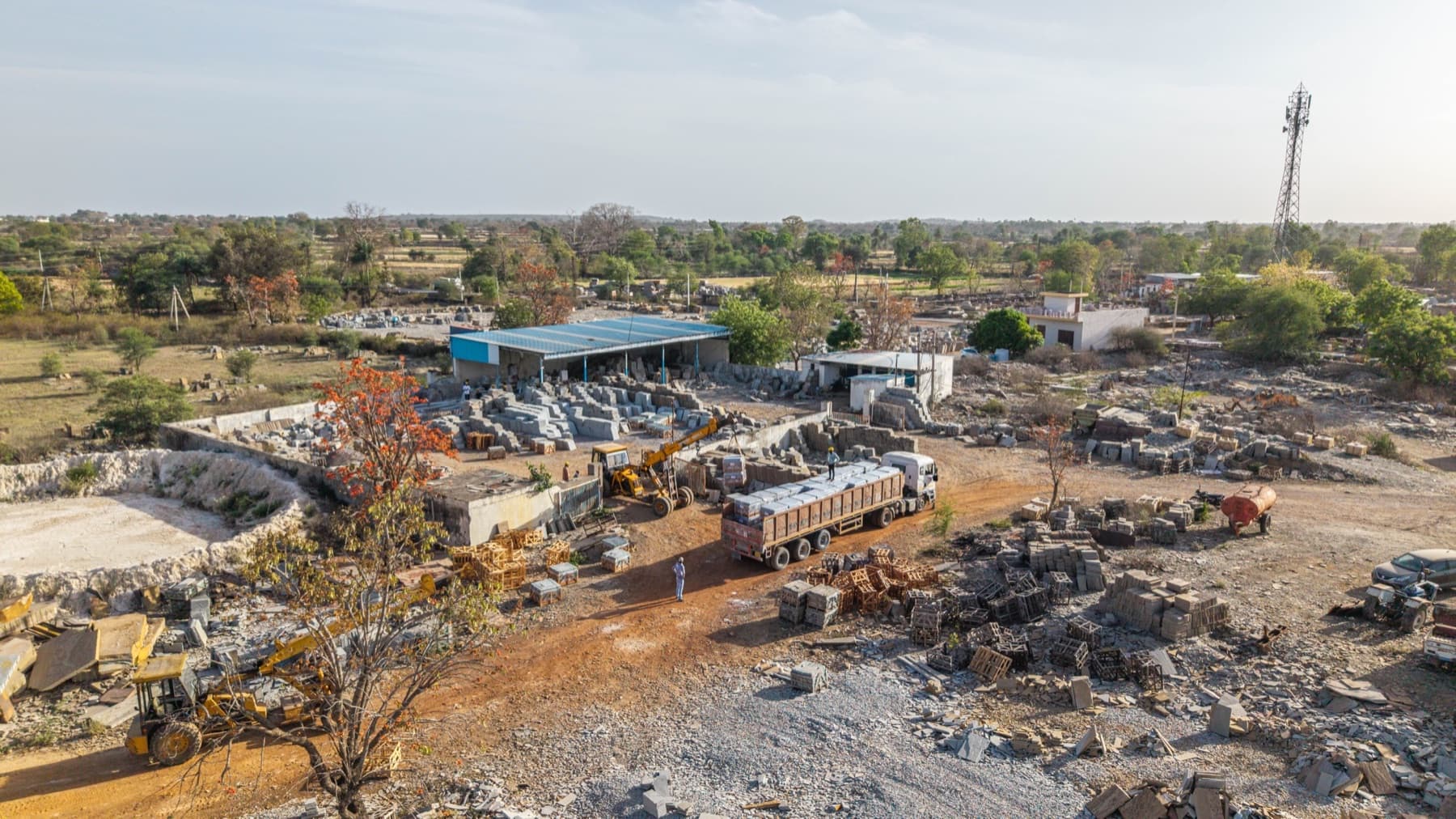
Hand-picking is the last quality control gate before container loading. Every piece passes a single inspection cycle against the approved sample. What does "approved sample" actually mean, and what does the inspector look for?
The approved sample.
Before any order ships, the buyer receives a set of physical samples — typically three to five pieces per variety and format. These represent the variation range the buyer is signing off on. The samples are catalogued and held at the yard for the duration of production. Every piece hand-picked for the order is compared against these samples.
This is not a strict numerical match. Sandstone is a natural material — variation is inherent and not grounds for rejection. The samples define the acceptable range, not a single ideal.
The four inspection criteria.
First, grain consistency. The grain pattern across a piece should match the sample range. Patches that look noticeably different from the bulk — either much finer or much coarser — are pulled.
Second, edge condition. The pieces should have clean, machine-cut edges with no significant chipping or feathering. Riven faces are an exception — these are deliberately irregular.
Third, surface uniformity. The finish should match the sample. Riven, honed, sawn, sandblasted, flamed — each has a defined surface signature. Pieces that drift from that signature are pulled.
Fourth, dimensional tolerance. Length, width, and thickness should fall within the calibration band agreed at order. Pieces outside band are pulled.
The reject pile.
Reject pieces are photographed, batched, and reported to the buyer. The reject percentage is part of the loading documentation. A normal export-grade reject rate sits around 8–12% across most varieties. Higher rates indicate either an unusually variable block or an inspector who is being conservative.
Pieces that fail inspection do not disappear. They are recycled into lower-grade orders, domestic supply, or reused as cobbles and setts depending on size.
What you order is what you ship. Nothing else.
DELIVERED MONTHLY
The Field Notes letter.
One brief per month. Geology, process, or trade. Sent only to specifiers and importers.
Subscribe →Hand-picking: what we actually inspect. · FN-006